- Article

- Innovation & Transformation
- Digital Adoption
A prescription for global growth: Hong Kong as a springboard for healthcare companies
For healthcare companies pursuing international growth, scientific innovation is only part of the equation. Turning research into commercial opportunity also requires access to capital, effective cross-border operations and connections with investors and business partners.
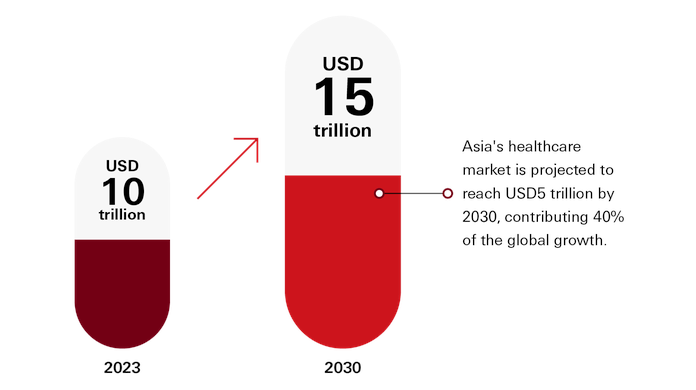
Asia is an important part of that opportunity. The region’s healthcare market is projected to reach USD5 trillion by 2030 and account for 40% of global sector growth over that period, according to the Boston Consulting Group.1 Policy reform, rising healthcare demand and continued investment in innovation are creating significant opportunities across the sector, from contract research organisations and active pharmaceutical ingredient producers to established pharmaceutical companies, biotech firms, medical device and supply manufactureres and healthcare services providers.
Global healthcare market size
A convergence of advantages
Yet scientific innovation alone is not enough to drive sustainable growth. Healthcare companies must navigate lengthy development cycles, evolving regulatory environments and complex cross-border operations.
Hong Kong offers a base from which to address these challenges. Since introducing its biotech listing regime in 2018,2 the city has strengthened its role as a healthcare financing centre while deepening its connections with both Chinese Mainland and global markets.
The city combines several advantages that support healthcare companies as they fund, commercialise and expand internationally.
- A gateway to Chinese Mainland and global markets, connecting healthcare companies with investors, business partners and growth opportunities across the region and beyond.
- Access to diverse funding channels across the business life cycle, including equity, debt financing and mature public markets.
- The world’s largest offshore renminbi centre, handling more than 75% of global offshore renminbi transactions.3
- A highly skilled talent pool and trusted common law system that support innovation and international business.
- A competitive treasury environment, where qualifying corporate treasury centres can access a profits tax rate of 8.25%4 and face no restrictions on currency conversion or cross-border transfers.
This combination can be particularly valuable for overseas pharmaceutical companies exploring routes into the Greater Bay Area. Rather than approaching the region solely as an export market, businesses can use Hong Kong to coordinate financing and partnerships while gaining a clearer understanding of local market conditions. Companies based in Chinese Mainland can likewise use the city as a platform for engaging international investors and advisers.
Three forces shaping healthcare innovation and growth

AI and digital health are changing care delivery
- Artificial intelligence (AI) and clinical decision-support tools are already playing a role in diagnosis and clinical care, drug development, disease surveillance and health-system management. The World Health Organization has published guidance on ethics, governance and regulatory considerations to support the responsible adoption of AI in healthcare. ⁵
- For technology providers, the opportunity extends beyond developing the underlying product to establishing the partnerships and commercial models required for adoption in multiple markets.
The implication:
Innovation must be matched by a viable route to market, with financing and expansion planned alongside product development.

Precision medicine is enabling more personalised care
- Precision medicine uses clinical, molecular, genomic and other health data to guide prevention, diagnosis and treatment, taking individual differences into account. In 2026, the World Health Assembly endorsed a resolution supporting its safe, ethical and equitable integration into health systems.⁶
- This creates opportunities for biotechnology companies, diagnostics providers and other specialised businesses, but it can also result in more complex development and commercialisation journeys.
- Companies may need to coordinate research, intellectual property and funding across several locations, as well as different partners at various stages of growth.
The implication:
Funding and banking arrangements need to work across research, intellectual property and commercialisation in several markets at once.

Cross-border healthcare innovation is accelerating
- Hong Kong is taking steps to strengthen its position as a healthcare and life sciences hub, connecting healthcare innovators with international capital, expertise and commercial opportunities.
- The planned establishment of the Hong Kong Centre for Medical Products Regulation by the end of 2026⁷ signals a greater focus on building regulatory capabilities and supporting healthcare innovation.
- These developments could strengthen Hong Kong’s attractiveness as a location for healthcare companies seeking to conduct research, commercialise products and expand internationally.
The implication:
Healthcare companies need partners who can support cross-border expansion, manage international operations and connect them with opportunities across multiple markets.
The pressure points to manage
Strong demand does not remove the risks associated with healthcare growth. Companies must manage several closely connected issues:
- Research and development costs: Healthcare innovation can require substantial investment before a product generates commercial revenue.
- Funding runway: Lenders and investors may focus closely on cash burn, liquidity and the company’s ability to reach its next development milestone.
- Regulatory complexity: Requirements can differ considerably between markets, making local knowledge important when planning expansion.
- Supply-chain exposure: Geopolitical disruption can affect access to specialist materials, equipment and production capacity.
- Commercialisation risk: A promising technology still needs the right manufacturing, distribution and market partnerships.
- Coordination across markets: International growth can create additional currencies, accounts, payment processes and reporting requirements.
Case study
Pharmaron, a global contract research, development and manufacturing organisation, has expanded across China, the US and the UK, supporting clients across throughout new drug development value chain with fully integrated and end-to-end research, development and manufacturing services.
As the company grew internationally, HSBC supported Pharmaron with financing, liquidity management and international banking capabilities, complemented by strategic guidance and coordination of treasury operations across markets.
HSBC: sector expertise applied
At HSBC, we understand that healthcare companies require different forms of support as they progress through their business life cycle. Early-stage businesses may be focused on funding and development. More established companies may be preparing for commercialisation, expanding into new markets or strengthening their international operations.
Our dedicated healthcare team combines sector expertise with financing, payments, banking advisory support and global connectivity to provide tailored support at each stage:
- Working capital and pre-IPO financing: Support development, operations and the preparation required ahead of a listing.
- Global Payments Solutions: Facilitate domestic and international transactions, while improving visibility and control over cash flow and liquidity.
- Listed-company support: Help more mature businesses manage ongoing financing, treasury and international banking requirements after listing.
- Dedicated relationship managers: Provide healthcare sector expertise and help tailor solutions to each company’s growth priorities.
- International network and ecosystem connections: Connect companies with HSBC’s international network, as well as ecosystem partners and investors.
Hong Kong is becoming a springboard for healthcare companies pursuing international growth. The companies that benefit most will be those that combine scientific innovation with the funding and market insight required to grow sustainably.
That is where HSBC’s sector expertise adds value. By combining Hong Kong market knowledge with international reach, we can help healthcare businesses connect capital, partnerships and opportunities across markets.
Start the conversation today
Contact our sector expert to explore how we can support your growth plans.
Important notes:
- Reminder: “To borrow or not to borrow? Borrow only if you can repay!”
- The information shown on this page is general advice only and is not intended to constitute a recommendation or advice to any prospective customer and is not intended as a substitute for professional advice. All prospective customers and readers should not act on any information on this page without seeking specific professional advice.
- The information shown is based on data obtained from sources believed to be reliable but the Bank and the concerned Information Provider(s) make no representation and accept no responsibility as to its accuracy or completeness and shall not be held liable for damages arising out of or in connection with any person's reliance upon this information. This information is neither a recommendation, an offer to sell nor solicitation of an offer to purchase any investment. The prices quoted and the other information shown are for reference only and are subject to change without notice.
- All applications are subject to the applicable terms and conditions which will be set out in the application form, key fact sheet statement, loan notification letter and relevant materials. All applications are subject to the Bank’s usual approval procedure.
1 Boston Consulting Group, The Unmissable Asia Healthcare Opportunity, 27 January 2025
2 Hong Kong Exchanges and Clearing Limited, Hong Kong’s Listing Regime Enters New Era, Featuring Emerging and Innovative Firms, 24 April 2018
3 SWIFT, Global Currency Tracker, July 2026
4 Inland Revenue Department, The Government of the HKSAR, 7 September 2026
5 World Health Organization, Harnessing Artificial Intelligence for Health, 2026